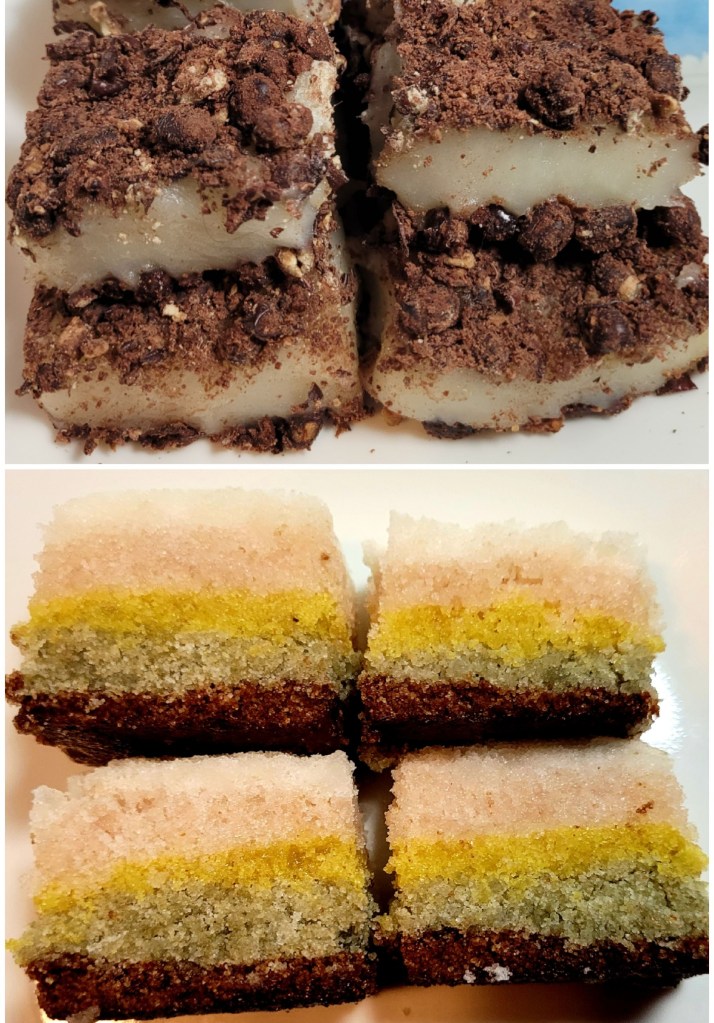
Tteok, or rice cakes, have been an important part of Korean cuisine since their creation in 500 B.C. There are several different variations of rice cakes. The two types of rice cakes pictured here, muijigae-tteok (rainbow rice cake) and pat sirutteok (red bean rice cake) are made from two different types of rice flour: wet rice flour and glutinous rice flour. I made the rice flour, used period natural dyes, and steamed the rice cakes. These rice cakes both have a chewy texture, but in a different way. The steamed wet rice flour has a slightly more crumbly texture, while the glutinous rice flour has a much smoother texture. Both of these desserts are gluten free and the amount of sweetness can be adjusted to taste. Tteok in Korean royal cuisine was not only a dessert, but also used as a decorate center piece during feasts and banquets in large piles and towers that were beautifully arranged.
Both of the recipes used are excerpts from a virtual Korean feast that I created for the elevation of Seong Myeong Su Daegam to the Order of the Laurel in the Kingdom of Meridies that will happen on February 7th, 2021. The feast is based on an elders 61st (Korean) or 60th (western) birthday celebration known as 환갑 hwangap. In SCA period Korea, there was a shorter life expectancy, so hwangap was a celebration of longevity. Some of the meal aspects of hwangap are similar to 돌잔치 doljanchi, a baby’s first birthday celebration, a major milestone. The two types of rice cakes that are pictured are essential to a traditional Korean birthday.
Muijigae-tteok, also called saekpyeon (colored rice cake) or osaekpyeon (five colored rice cake), is representative of obangsaek, which represents balance and harmony in the universe. The colors of each layer are brown (black), green (blue), yellow, pink (red), and white. Each of these colors represents one of the five elements: fire, water, tree, metal, and earth. Each also represents one of the five directions: north, south, east, west, and center. Muijigae-tteok is also commonly made with three colors rather than five. Wet rice flour made from short grain rice is used to create this rice cake. Food coloring is commonly used in the Known World.
Pat sirutteok was traditionally important to include in birthday celebrations, important occasions, and rituals because of the red bean. A traditional Korean belief is that red beans ward off evil spirits due to their color. Dry sweet rice flour (also known as glutinous rice flour) made from glutinous rice is used to create this rice cake. Though it is called glutinous rice, it does not contain any gluten. It does, however, have a higher starch content than other types of rice.
While there are references and descriptions of tteok and other Korean cuisine, the actually recipes themselves were not commonly written down. Traditionally, recipes were passed down orally and through demonstration. Because of this, every household and every region in Korea may have a slightly different version of these recipes that are passed down from generation to generation. I have translated and standardized the recipes to allow for replication using traditional ingredients. An example of the translation of the recipe that was orally taught and demonstrated to me is that the literal translation is not always correct. An example of this is the English translation, “If you don’t add salt to the beans, the beans will be lonely.” The actual intent, however, is to convey that the beans will lack flavor if the salt is not added in. One thing that was difficult while translating and trying to write in a standardized way was conveying the correct texture and thickness needed for these recipes. A note for anyone who would like to make these recipes – give yourself plenty of time as these recipes, especially if you are making your own rice flour.





 Tink's Table